Tuesday, January 5, 2016

Ice dams

The freezing rain and snowfall in Kansas City over the holidays, probably made you notice the gutters on your house.

Icicles may look pretty and seasonally appropriate, but they're also a sign that heat is escaping through your roof and causing the snow cover to melt. As the melting snow refreezes, it can block the gutters and keep water from draining away as it should. Then, when the ice and snow melted for good, water may have seeped into your walls or dripped onto your house's foundation instead. That can lead to many different problems.

Now that we're not expecting any winter weather for a bit, clear away any debris in your gutters. This will help freezing drizzle and snow melt to drain away more easily next time.

And, next time it snows, consider using a broom to brush away the snow from lowest few feet of your roof. You may feel silly being out in the cold "sweeping" your roof, but giving the snow melt room to drain unobstructed can help you avoid costly problems with mold, a cracked foundation, and damaged soffits, fascia boards and walls.

To prevent ice dams from occurring, you may need to improve the insulation and ventilation of your roof and/or install a heat strip along the lower edge of the roof or in the gutter. For now, sweeping the snow away will help the situation. And then, when it warms up a little, you can consider your other options. 

Whole house inspections, condo inspections, radon testing, mold testing and more, we do it all for you. Call or E-mail today to schedule your Complete Home Inspection, 913-268-0222, www.completehomeinspectionkc.com.

Friday, December 18, 2015

January is Kansas Radon Action Month

January 2016 is both Kansas Radon Action Month (KRAM) (sponsored by the Kansas Radon Program (KRP) and the Kansas Department of Health and Environment (KDHE)) and National Radon Action Month (NRAM) (sponsored nationally by the EPA), designed to educate residents about the dangers of radon exposure and encourage actions to identify and address radon problems in the home. Radon is a tasteless, odorless, colorless, naturally occurring radioactive gas found in nearly all soils which comes from the breakdown of uranium. Outdoors, radon is diluted to low concentrations, but once inside an enclosed space, radon can accumulate to significant levels.

About one out of every three radon measurements performed in Kansas are elevated, being above 4 pCi/l (picoCuries per liter). In 2015, Johnson, Wyandotte and Leavenworth counties in Kansas each recorded average radon values in excess of 4.0 pCi/L from all tests conducted.


The best way to ascertain if your house, or the house you're looking to buy, has a radon problem is to have a certified radon professional, such as Miki Mertz of Complete Home Inspection, do a test for you. Complete Home Inspection uses a continuous radon monitor that takes samples over a period of two full days, with the test unit placed in the lowest livable level of the house. Windows are kept closed throughout the time of the test. The test results are then averaged into an overall number for your final report. As mentioned earlier, if the radon level is higher than 4.0piC/l, then it should be fixed, or "mitigated". In Kansas, all residential real estate contracts include a recommendation that home buyers include a radon test on homes purchased. All radon tests performed during real estate transactions in Kansas must be conducted by a state-certified radon tester, such as Miki Mertz of Complete Home Inspection.

Additional information about radon can be found on the Complete Home Inspection web site at http://www.completehomeinspectionkc.com/kansas_city_home_inspection_051.htm, at www.kansasradonprogram.org, and at www.epa.gov/radon.

Whole house inspections, condo inspections, radon testing, mold testing, and more, we do it all for you. Call or E-mail today to schedule your Complete Home Inspection, 913-268-0222, www.completehomeinspectionkc.com.
Thursday, October 29, 2015

Trend in housing

Housing experts say that the Millennial Generation likes to move into urban areas versus suburban areas. The trends indicate that living in the city is what appeals to Millennials and that their lifestyles don't require a lot of living space. If a loft or a condo is in your future, whether in an urban area or not, make certain to get the property inspected before you buy.

It's sometimes easy to think that you don't need to have a complete home inspection done on a condo or loft because they don't have many of the same concerns as a free-standing home (perhaps no roof immediately over your living space, perhaps no basement or crawl space immediately below your living space, etc.). But, as many have found by having a complete home inspection done for them, condos and lofts still had many systems and features that needed a complete inspection.

Your inspection includes the plumbing, electric, heating and cooling systems, as well as the appliances, doors, walls and windows. You get a lot of peace of mind from knowing the condition of each of these systems and items BEFORE you buy. You can test for mold, too, if you wish.

Whether it's a high-rise condo downtown or in the Plaza area, a townhouse-type condo with its own roof and foundation, or a loft in one of the magnificent old buildings downtown, have your property thoroughly inspected by Complete Home Inspection.

Condo inspections, whole house inspections, radon testing, mold testing, and more, we can do it all for you. Call or E-mail today to schedule your appointment, 913-268-0222. www.completehomeinspectionkc.com.

Monday, August 10, 2015

Regular Check-ups for Radon Gas

The Weather Channel recently aired a report on the rising levels of radon gas in homes in the northwest. As detailed in the March 9, 2013 post on this blog, deadly radon gas finds new ways to get into your house during periods of drought. That's what's happening now in the northwest. Due to their extended drought, the ground has been moving, shrinking, and cracking around and under foundations. That opens up new pathways for radon gas to escape the soil. And, the movement of the earth can cause new cracks to form in foundations, which opens up new pathways for radon to then get into houses.

This summer, drought hasn't been an issue in Kansas City. But conditions have still been changing over time in, around and under your house. So saying that you tested for radon once upon a time, doesn't guarantee that you'll now live happily ever after. In fact, the Kansas Department of Health and Environment recommends that you test your home's radon gas level every two years. And it's particularly important to do when you're buying a new property. Radon is a naturally existing radioactive gas found underground. It is the leading cause of lung cancer in non-smokers, and the second leading cause among smokers. You can't smell it or see it, but for about three out every five homes tested in our area, it's there and at dangerous levels.

Here's what's involved - Complete Home Inspection uses a continuous radon monitor that takes samples over a period of two full days. The test unit is placed in the lowest livable level of the house. Windows are kept closed throughout the time of the test.  The test results are then averaged into an overall number for your final report. If the radon level is higher than 4.0piC/l, then it should be fixed, or "mitigated". In Kansas, your home must be tested by a certified radon tester. Missouri has no certification program as of yet, but it simply makes sense to have a trained professional handle your test for you. Inexpensive do-it-yourself test kits are not what you want to rely on when it comes to your family's health and well-being. Instead, rely on the knowledge and competence of a certified radon tester. I'm a Kansas certified radon tester and have been certified by the NRPP (National Radon Proficiency Program) for years. So, play it safe. Give me a call.
 
Whole house inspections, condo inspections, radon testing, mold testing, and more, we do it all for you. Call or E-mail today to schedule your Complete Home Inspection, 913-268-0222, www.completehomeinspectionkc.com.

Saturday, July 11, 2015

Another reason to have your house inspected


You have so many things on your mind when buying a house that you don't have time to check every little detail. That's my job. And far too often, the devil is in the details. Viewed from the attic access, things looked normal in this particular attic.  
home inspector Kansas City - Miki Mertz
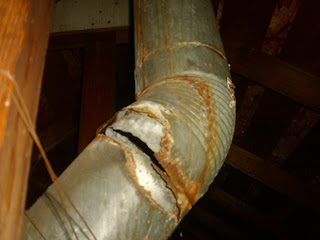
You see the furnace flue pipe at the upper right as it vents to the outside above the roof. What you don't see is the other side of the pipe. When I climbed through the very hot attic to look at the entire flue pipe, this is what I found - 
 
home inspector Kansas City - Miki Mertz


The side hidden from view from the attic access had a big hole in it. This tear in the pipe could be deadly for you and your family. The furnace and water heater exhaust fumes that escaped through this gash would settle back down into the house as they cooled. You could be breathing carbon monoxide. Plus, the moisture in those escaping fumes would cause the roof to rot and could lead to mold in the attic. Finally, the gash in the flue pipe keeps the exhaust system from being pressurized so it won't vent the furnace and the water heater properly, which causes exhaust gases to back draft into the living space. That leads to inefficient operation of both of those appliances and causes them to wear out faster.

All of this results from something that can't be seen by just popping your head up into the attic and saying, "Yeah, everything looks normal." I can't always walk through attics. But, finding a major problem like this, I'm glad I did this time. And this is certainly something you wouldn't have seen for yourself when you were looking at the house.

Whole house inspections, condo inspections, radon testing, mold testing, and more, we do it all for you. Call or E-mail today to schedule your Complete Home Inspection, 913-268-0222, www.completehomeinspectionkc.com.

Saturday, June 20, 2015

Changes to water heaters

New water heaters are going to be larger from now on due to requirements for more insulation in the tank area. That could mean a lot for your existing house or the house you're now looking to buy. Some water heaters are tucked away neatly in little closet-type rooms. When those water heaters need to be replaced, the new units may not fit into those small rooms. New tanks are taller, so, even a free-standing water heater that currently doesn't have anything else near it will perhaps need new plumbing and vent pipes for its replacement due to the bigger, taller size of the new unit.

If you choose a high-efficiency water heater, it will need to be vented differently to the outside. So, a new water heater simply may not fit in the space occupied by the old one because it is larger, shaped a little differently, and may need to be vented  through an outside wall, away from windows and doors. In other words, replacing a water heater could get kind of complicated in the future. Something for you to keep in mind and plan for when looking to buy a house.

Whole house inspections, condo inspections, radon testing, mold testing, and more, we do it all for you. Call or E-mail today to schedule your Complete Home Inspection, 913-268-0222, www.completehomeinspectionkc.com.

Sunday, May 31, 2015

Rain, rain, go away

There were just four days in this month of May when it didn't rain in Kansas City. Maybe five, depending on what happens today. March 22nd's blog post included tips on preparing for our rainy season - clean out your gutters, improve the drainage around your house's foundation by sloping the ground away from the house, and, keep the gutters and downspouts free from debris. 

But the ground is so saturated now, even those preventative measures may not have kept water out of your basement. Houses that usually stay dry in heavy rains are getting wet this month. The Kansas City Star newspaper quotes a foundation contractor as saying, "When that water table in the ground gradually starts to increase...our basements literally become pools waiting to fill up." What to do now?

First, protect your belongings by getting them off the basement floor. Then, make sure your sump pump, if you have one, is plugged in and working. Yes, make sure it's plugged in. An amazing number of sump pumps are unplugged by home owners for various reasons. Make certain that yours is working. And do the preventative measures mentioned above. If water is still getting into your basement, it's time to call a professional contractor. Or, learn to tread water.

Whole house inspections, condo inspections, radon testing, mold testing and more, we do it all for you. Call or E-mail today to schedule your own Complete Home Inspection, 913-268-0222, www.completehomeinspectionkc.com.