Monday, August 10, 2015

Regular Check-ups for Radon Gas

The Weather Channel recently aired a report on the rising levels of radon gas in homes in the northwest. As detailed in the March 9, 2013 post on this blog, deadly radon gas finds new ways to get into your house during periods of drought. That's what's happening now in the northwest. Due to their extended drought, the ground has been moving, shrinking, and cracking around and under foundations. That opens up new pathways for radon gas to escape the soil. And, the movement of the earth can cause new cracks to form in foundations, which opens up new pathways for radon to then get into houses.

This summer, drought hasn't been an issue in Kansas City. But conditions have still been changing over time in, around and under your house. So saying that you tested for radon once upon a time, doesn't guarantee that you'll now live happily ever after. In fact, the Kansas Department of Health and Environment recommends that you test your home's radon gas level every two years. And it's particularly important to do when you're buying a new property. Radon is a naturally existing radioactive gas found underground. It is the leading cause of lung cancer in non-smokers, and the second leading cause among smokers. You can't smell it or see it, but for about three out every five homes tested in our area, it's there and at dangerous levels.

Here's what's involved - Complete Home Inspection uses a continuous radon monitor that takes samples over a period of two full days. The test unit is placed in the lowest livable level of the house. Windows are kept closed throughout the time of the test.  The test results are then averaged into an overall number for your final report. If the radon level is higher than 4.0piC/l, then it should be fixed, or "mitigated". In Kansas, your home must be tested by a certified radon tester. Missouri has no certification program as of yet, but it simply makes sense to have a trained professional handle your test for you. Inexpensive do-it-yourself test kits are not what you want to rely on when it comes to your family's health and well-being. Instead, rely on the knowledge and competence of a certified radon tester. I'm a Kansas certified radon tester and have been certified by the NRPP (National Radon Proficiency Program) for years. So, play it safe. Give me a call.
 
Whole house inspections, condo inspections, radon testing, mold testing, and more, we do it all for you. Call or E-mail today to schedule your Complete Home Inspection, 913-268-0222, www.completehomeinspectionkc.com.

Saturday, July 11, 2015

Another reason to have your house inspected


You have so many things on your mind when buying a house that you don't have time to check every little detail. That's my job. And far too often, the devil is in the details. Viewed from the attic access, things looked normal in this particular attic.  
home inspector Kansas City - Miki Mertz
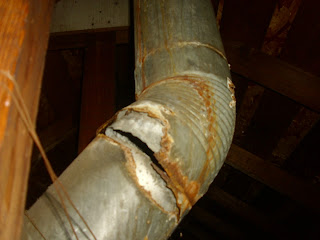
You see the furnace flue pipe at the upper right as it vents to the outside above the roof. What you don't see is the other side of the pipe. When I climbed through the very hot attic to look at the entire flue pipe, this is what I found - 
 
home inspector Kansas City - Miki Mertz


The side hidden from view from the attic access had a big hole in it. This tear in the pipe could be deadly for you and your family. The furnace and water heater exhaust fumes that escaped through this gash would settle back down into the house as they cooled. You could be breathing carbon monoxide. Plus, the moisture in those escaping fumes would cause the roof to rot and could lead to mold in the attic. Finally, the gash in the flue pipe keeps the exhaust system from being pressurized so it won't vent the furnace and the water heater properly, which causes exhaust gases to back draft into the living space. That leads to inefficient operation of both of those appliances and causes them to wear out faster.

All of this results from something that can't be seen by just popping your head up into the attic and saying, "Yeah, everything looks normal." I can't always walk through attics. But, finding a major problem like this, I'm glad I did this time. And this is certainly something you wouldn't have seen for yourself when you were looking at the house.

Whole house inspections, condo inspections, radon testing, mold testing, and more, we do it all for you. Call or E-mail today to schedule your Complete Home Inspection, 913-268-0222, www.completehomeinspectionkc.com.

Saturday, June 20, 2015

Changes to water heaters

New water heaters are going to be larger from now on due to requirements for more insulation in the tank area. That could mean a lot for your existing house or the house you're now looking to buy. Some water heaters are tucked away neatly in little closet-type rooms. When those water heaters need to be replaced, the new units may not fit into those small rooms. New tanks are taller, so, even a free-standing water heater that currently doesn't have anything else near it will perhaps need new plumbing and vent pipes for its replacement due to the bigger, taller size of the new unit.

If you choose a high-efficiency water heater, it will need to be vented differently to the outside. So, a new water heater simply may not fit in the space occupied by the old one because it is larger, shaped a little differently, and may need to be vented  through an outside wall, away from windows and doors. In other words, replacing a water heater could get kind of complicated in the future. Something for you to keep in mind and plan for when looking to buy a house.

Whole house inspections, condo inspections, radon testing, mold testing, and more, we do it all for you. Call or E-mail today to schedule your Complete Home Inspection, 913-268-0222, www.completehomeinspectionkc.com.
Sunday, May 31, 2015

Rain, rain, go away

There were just four days in this month of May when it didn't rain in Kansas City. Maybe five, depending on what happens today. March 22nd's blog post included tips on preparing for our rainy season - clean out your gutters, improve the drainage around your house's foundation by sloping the ground away from the house, and, keep the gutters and downspouts free from debris. 

But the ground is so saturated now, even those preventative measures may not have kept water out of your basement. Houses that usually stay dry in heavy rains are getting wet this month. The Kansas City Star newspaper quotes a foundation contractor as saying, "When that water table in the ground gradually starts to increase...our basements literally become pools waiting to fill up." What to do now?

First, protect your belongings by getting them off the basement floor. Then, make sure your sump pump, if you have one, is plugged in and working. Yes, make sure it's plugged in. An amazing number of sump pumps are unplugged by home owners for various reasons. Make certain that yours is working. And do the preventative measures mentioned above. If water is still getting into your basement, it's time to call a professional contractor. Or, learn to tread water.

Whole house inspections, condo inspections, radon testing, mold testing and more, we do it all for you. Call or E-mail today to schedule your own Complete Home Inspection, 913-268-0222, www.completehomeinspectionkc.com.

Wednesday, May 6, 2015

Defect of the Week

Three different houses in one week had furnace filters that were installed backwards. That doesn't sound like a big deal, but it really is. First of all, the filter itself is designed with wire or cardboard reinforcing on one side. If the filter is installed backwards, that reinforcement can’t protect the filter material from being sucked in towards the blower, which can cause serious damage to the blower. When installing your filter, check to see if there is an arrow on the edge of the filter. That arrow should point towards the furnace, not back into the return air duct.

Most people think the filter’s job is to keep the house clean. It does, to some extent. But, the filter’s most important job is to keep the blower and all of the interior parts of the furnace and air conditioner clean. That way they work more efficiently. A dirty filter restricts air flow through the heating and cooling system, causing it to overheat and age faster. So, change your filter regularly.

And, another thing to remember is that your "furnace" filter doesn't just work when the furnace is running. Most heating and cooling systems in houses run air through the filter for the air conditioner, too. So now is the time to check your furnace filter, look for the arrows indicating the direction of airflow, and make certain that it installed correctly. Or, have me check it when I'm inspecting the house for you. You will, literally, breathe easier.

Whole house inspections, condo inspections, radon testing, mold testing, and more, we do it all for you. Call or E-mail today to schedule your Complete Home Inspection, 913-268-0222, www.completehomeinspectionkc.com.

Tuesday, April 7, 2015

Indoor air quality

It's time to open the windows, let in some fresh air, and enjoy springtime in Kansas City. As you do that, take some time to also check on any problems with your indoor air quality that might have developed over the winter.

We're all saddened by the story from Maryland of the family of eight killed by carbon monoxide poisoning. And in four different Kansas City home inspections in the past few weeks, I discovered gas leaks inside the houses.

Your furnace, either in your existing house or in the one you're looking to buy, had a rough winter heating season. Get it checked by a professional to make sure it's still burning efficiently and venting carbon monoxide fumes outside of the house. The same is true if you have a gas water heater. It will be running all year long, not just during the winter.

And, for gas leaks, just use your nose to detect the gas odor. As the ground shifts during periods of freezing and thawing, gas pipes move. That can put stress on pipe joints and create deadly and explosive leaks.

So, while you're enjoying the fresh outside air after a season of being indoors, take some precautionary steps to ensure your health and safety next winter.

Whole house inspections, condo inspections, radon testing, mold testing, and more, we do it all for you. Call or E-mail today to schedule your Complete Home Inspection, 913-268-0222, www.completehomeinspectionkc.com.

Sunday, March 22, 2015

It's time to clean up


Time for some spring/summer maintenance on your house as we get ready for the rainy season and the heat. First, clean out your gutters. Whether you're buying or selling a home, or just maintaining the one you live in, it's time for this twice-a-year chore.

It's easy to remember to do this in the Fall because all of the falling leaves clog things up. But, it's just as important to do in the Spring now that the blossoms from flowering trees are down and
the maple tree "helicopter seeds" are next. Clogged gutters and downspouts lead to overflows and back ups that can put water in your basement. The clogs keep rainwater from flowing away from your house's foundation. Instead, it seeks out the cracks in your basement walls. So, now's the time to improve the drainage around your house's foundation by sloping the ground away from the house. And, keep the gutters and downspouts free from debris.

Then, check the condition of the outdoor section of your air conditioner. It should be relatively level and the outer coil should be clean. Dirt, pollen, cottonwood fluff, dryer lint and vegetation can clog the outdoor coil, causing it to work harder and waste money. I don't recommend power washing the outer coil. That is too harsh and can damage the coil or force the dirt farther into it. Gently brushing the debris down off of the coil or washing it with a garden hose is better. Some types of condenser units do need professional cleaning because of their design.

Thirdly, check the drainage on the interior part of your air conditioner, usually right above your furnace. If the drain hose is clogged, it can flood your furnace and ruin it. Once, a client buying a million-dollar condo simply said, "This inspection just paid for itself" when I opened the closet door to the air conditioner and found the drain pan overflowing, flooding the furnace and the floor, and starting to get the carpet wet. Make certain that the drain hose/pipe is near a floor drain or whatever your system is supposed to drain into. Sadly, simply seeing water flow doesn't necessarily mean that everything's okay. Remove the furnace's access panel and look for water. Remove the drain hose from the air conditioner and check for current or future clogs.

Whole house inspections, condo inspections, radon testing, mold testing and more, we do it all for you. Call or E-mail today to schedule your own Complete Home Inspection, 913-268-0222, www.completehomeinspectionkc.com.